

Wines, Grapes and Top Areas

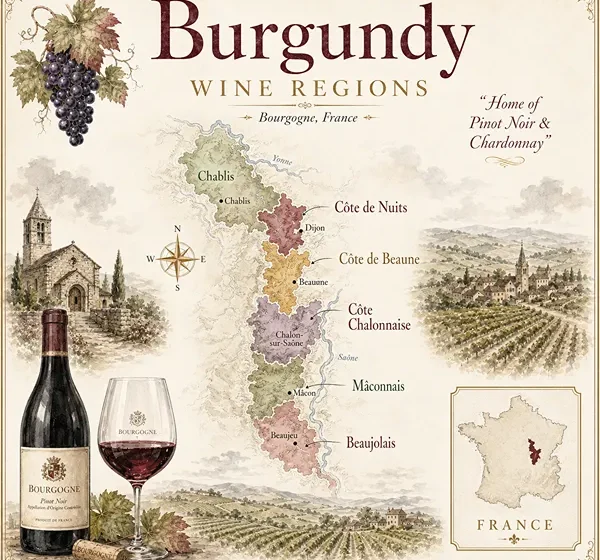
What is the Burgundy wine region?
The Burgundy wine region is one of the most prestigious and influential wine areas in the world, located in eastern France. Known for producing exceptional wines, especially from Pinot Noir and Chardonnay grapes, Burgundy stands out for its deep connection to terroir — the unique combination of soil, climate, and tradition that defines each wine’s character.
Unlike many other wine regions, Burgundy focuses less on blending different grape varieties and more on expressing the individuality of each vineyard. This makes it a fascinating destination for wine lovers seeking authenticity, history, and complexity in every glass.
The main areas of the Burgundy wine region
The Burgundy wine region is divided into several key sub-regions, each with its own identity and style of wine. Understanding these areas is essential to appreciating Burgundy wines.
Chablis
Located in the northern part of the Burgundy wine region, Chablis is famous for its crisp, mineral-driven white wines made exclusively from Chardonnay. The cool climate and limestone-rich soils give these wines their signature freshness and elegance.
Côte de Nuits
The Côte de Nuits is renowned for producing some of the finest red wines in the world. Here, Pinot Noir dominates, creating wines that are rich, complex, and capable of aging for decades. Many of Burgundy’s most prestigious vineyards are found in this area.
Côte de Beaune
South of the Côte de Nuits, the Côte de Beaune is known for its outstanding white wines, particularly those made from Chardonnay. However, it also produces excellent red wines. This area is home to some of the most famous wine villages in Burgundy.
Côte Chalonnaise
Often overlooked, the Côte Chalonnaise offers excellent value wines. Both red and white wines are produced here, typically with great balance and approachable styles, making them ideal for everyday enjoyment.
Mâconnais
The southernmost part of the Burgundy wine region, the Mâconnais is known for producing high-quality yet affordable Chardonnay wines. The warmer climate results in richer, fruitier wines compared to those from the north.
Grape varieties in the Burgundy wine region
One of the defining features of the Burgundy wine region is its simplicity in grape varieties.
Pinot Noir
Pinot Noir is the primary grape used for red wines in Burgundy. It is known for producing elegant wines with flavors of red fruit, earth, and spice. However, it is also a delicate grape that requires precise conditions to thrive.
Chardonnay
Chardonnay dominates white wine production in the Burgundy wine region. These wines can range from fresh and mineral-driven to rich and complex, depending on where they are grown.
Other varieties
While Pinot Noir and Chardonnay are the stars, other grapes like Aligoté and Gamay are also used. These produce lighter, more approachable wines and are often enjoyed locally.
The importance of terroir in Burgundy
The concept of terroir is central to understanding the Burgundy wine region. Even small differences in soil composition, slope, and exposure to sunlight can significantly affect the flavor of the wine.
This is why Burgundy wines are classified based on where the grapes are grown rather than who produces them. The region has over 100 appellations, each reflecting a specific geographic area and quality level.
Burgundy wine classification system
The Burgundy wine region uses a hierarchical classification system that helps consumers understand the quality and origin of each wine.
Grand Cru
These are the highest-quality wines, produced from the best vineyard sites. They are rare, complex, and often very expensive.
Premier Cru
Premier Cru wines come from high-quality vineyards but are slightly less prestigious than Grand Cru. They still offer excellent complexity and aging potential.
Village wines
These wines are produced within specific villages and reflect the general characteristics of that area.
Regional wines
At the base of the pyramid are regional wines, which are typically more accessible and easier to drink, making them ideal for beginners exploring the Burgundy wine region.
A rich history of winemaking
The Burgundy wine region has a long and fascinating history that dates back to Roman times. However, it was during the Middle Ages that monks played a crucial role in developing vineyards and understanding the concept of terroir.
Over centuries, Burgundy has built a reputation for producing some of the finest wines in the world. Today, it remains a benchmark for quality and craftsmanship in winemaking.
Why the Burgundy wine region is so special
What truly sets the Burgundy wine region apart is its unique combination of tradition, terroir, and precision. The focus on small vineyard plots and minimal intervention allows each wine to express its origin in a pure and authentic way.
Whether you are tasting a simple regional wine or a prestigious Grand Cru, Burgundy offers an experience that is deeply connected to the land and its history.
What wine regions are in Burgundy?
The Burgundy wine region is divided into several important wine-producing areas, each with its own personality, climate, soils, and wine style. The main regions are Chablis, Côte de Nuits, Côte de Beaune, Côte Chalonnaise, and Mâconnais. Some classifications also include Beaujolais, although it is often discussed separately because its wines are mainly made from Gamay rather than Pinot Noir or Chardonnay.
Chablis, located in the north, is famous for crisp, mineral white wines made from Chardonnay. Moving south, the Côte de Nuits is the heartland of great red Burgundy, producing some of the world’s most admired Pinot Noir wines. The Côte de Beaune is especially known for prestigious white Burgundy wines, although it also produces excellent reds.
Further south, the Côte Chalonnaise offers very good value Burgundy wines, including Pinot Noir, Chardonnay, Aligoté, and Crémant de Bourgogne. Finally, the Mâconnais is known for approachable, fruit-driven Chardonnay wines, including well-known names such as Pouilly-Fuissé.
Together, these areas make the Burgundy wine region one of the most diverse and fascinating wine destinations in France.
Is Burgundy Pinot Noir?
Burgundy is not only Pinot Noir, but red Burgundy wine is usually made from Pinot Noir. In the Burgundy wine region, Pinot Noir is the dominant grape for red wines, while Chardonnay is the dominant grape for white wines. This is one of the reasons Burgundy is so easy to understand in terms of grape varieties, yet so complex when it comes to terroir, appellations, and vineyard classification.
When someone says “red Burgundy,” they are usually referring to a wine made from Pinot Noir. These wines can range from light, elegant, and fruity to deep, earthy, structured, and age-worthy. The final style depends on where the grapes are grown, the vintage, and the producer.
However, Burgundy also produces white wines, mainly from Chardonnay. In fact, some of the most famous white wines in the world come from Burgundy, especially from areas such as Chablis, Meursault, Puligny-Montrachet, and Chassagne-Montrachet.
So, Burgundy is strongly associated with Pinot Noir, but it is more accurate to say that Burgundy is the historic home of both Pinot Noir and Chardonnay.
What is the American equivalent of Burgundy wine?
The closest American equivalent of Burgundy wine is usually found in Pinot Noir and Chardonnay from cool-climate regions, especially in areas such as Oregon’s Willamette Valley and parts of California, including Sonoma Coast, Russian River Valley, and Santa Barbara County.
For red Burgundy lovers, American Pinot Noir is the natural comparison. Like Burgundy, the best American Pinot Noir wines often focus on elegance, red fruit, acidity, and subtle earthy notes rather than heavy body or excessive power. Oregon is often compared with Burgundy because of its cooler climate and its focus on Pinot Noir.
For white Burgundy lovers, American Chardonnay can be a good alternative, especially when it is made in a restrained, mineral, and balanced style. Cooler parts of California and Oregon can produce Chardonnay with freshness, texture, and complexity similar to white Burgundy.
That said, there is no exact copy of the Burgundy wine region. Burgundy’s identity comes from its limestone soils, centuries of vineyard classification, and highly specific terroirs. American wines may be similar in grape variety and style, but Burgundy remains unique because of its history, geography, and appellation system.
What is better, Burgundy or Bordeaux?
Neither Burgundy nor Bordeaux is objectively better. They are two of France’s greatest wine regions, but they offer very different experiences.
The Burgundy wine region is best known for Pinot Noir and Chardonnay. Its wines are often described as elegant, expressive, subtle, and deeply connected to terroir. Burgundy focuses on small vineyard plots, and the exact location of the vines is extremely important. This makes Burgundy especially appealing to wine lovers who enjoy nuance, freshness, and complexity.
Bordeaux, on the other hand, is famous for blends, especially red wines made from Cabernet Sauvignon, Merlot, Cabernet Franc, Petit Verdot, and other grapes. Bordeaux wines are often more structured, powerful, and tannic, with flavors of black fruit, cedar, tobacco, and spice.
If you prefer lighter, more delicate reds or complex white wines, Burgundy may be the better choice. If you enjoy fuller-bodied reds with firm structure and aging potential, Bordeaux may suit your taste better.
In the end, the best choice depends on personal preference. Burgundy is about precision and terroir; Bordeaux is about structure and blending.
Which is the best Burgundy wine?
The “best” Burgundy wine depends on taste, budget, and occasion. At the highest level, Burgundy’s most prestigious wines are Grand Cru wines, produced from the region’s most respected vineyard sites. Famous names include Romanée-Conti, La Tâche, Chambertin, Montrachet, and Corton-Charlemagne. These wines are rare, expensive, and often designed for long aging.
However, the best Burgundy wine for most people is not necessarily the most expensive bottle. Burgundy offers excellent wines at different levels, including regional wines, village wines, Premier Cru wines, and Grand Cru wines.
For red Burgundy, villages such as Gevrey-Chambertin, Vosne-Romanée, Nuits-Saint-Georges, Volnay, and Pommard are highly respected. For white Burgundy, areas such as Chablis, Meursault, Puligny-Montrachet, Chassagne-Montrachet, and Pouilly-Fuissé are excellent choices.
If you are new to the Burgundy wine region, starting with a good village-level wine or Premier Cru can be a smart choice. These wines often offer a beautiful balance between quality, character, and price.
What wine is good for cholesterol?
No wine should be recommended as a treatment for cholesterol. Although some studies have linked moderate alcohol consumption with higher HDL, often called “good cholesterol,” major health organizations do not recommend starting to drink wine or any alcohol for health benefits. The American Heart Association states that it does not recommend drinking wine or any other alcohol to gain potential health benefits.
For people who already drink wine, moderation is important. The CDC defines moderate drinking as up to two drinks per day for men and up to one drink per day for women.
From a lifestyle perspective, cholesterol is usually better managed through medical advice, diet, exercise, weight management, and prescribed treatment when necessary. Red wine is sometimes discussed because it contains polyphenols such as resveratrol, but similar compounds can also be found in foods like grapes, berries, and other plant-based products without the risks associated with alcohol.
So, if this question appears in an article about the Burgundy wine region, the safest answer is: wine should be enjoyed for culture, flavor, and experience, not as a cholesterol remedy.
Best Burgundy wine region
The best Burgundy wine region depends on the style of wine you prefer. For red wine lovers, the Côte de Nuits is often considered the most prestigious area, especially for Pinot Noir. For white wine lovers, the Côte de Beaune and Chablis are among the most admired areas for Chardonnay. The Côte de Nuits is home to many legendary red Burgundy wines, while the Côte de Beaune produces some of the world’s finest white wines, including famous appellations such as Meursault, Puligny-Montrachet, and Chassagne-Montrachet.
However, the best Burgundy wine region is not always the most expensive one. Chablis is ideal for crisp, mineral white wines; Côte Chalonnaise offers excellent value; and Mâconnais is perfect for approachable Chardonnay. For travelers, the best choice may be the area that offers the richest wine-tour experience. Beaune, for example, is a natural starting point because it sits at the heart of Burgundy wine culture.
Burgundy wine color
Burgundy wine color can refer to both the appearance of the wine and the deep red shade inspired by red Burgundy wines. In wine terms, red Burgundy is usually made from Pinot Noir, which often gives a lighter, more transparent ruby color than fuller-bodied red wines such as Cabernet Sauvignon. As it ages, red Burgundy may develop garnet or brick tones.
White Burgundy, on the other hand, is made mainly from Chardonnay and can range from pale lemon to golden yellow depending on the region, age, and winemaking style. Chablis is usually pale and bright, while richer wines from the Côte de Beaune may show deeper golden tones. So, while “Burgundy” is often used as a color name, the actual Burgundy wine region produces both red and white wines.
Burgundy wine region facts
The Burgundy wine region is located in east-central France and is one of the most terroir-focused wine regions in the world. Its most important grapes are Pinot Noir for red wines and Chardonnay for white wines. Burgundy is divided into several main areas, including Chablis, Côte de Nuits, Côte de Beaune, Côte Chalonnaise, and Mâconnais.
One of the most important facts about Burgundy is that its classification system is based on vineyard location. Wines may be classified as Regional, Village, Premier Cru, or Grand Cru. This means that the exact place where the grapes are grown is central to the identity and value of the wine.
Another key fact is that Burgundy’s historic “climats” are recognized by UNESCO as a World Heritage Site. These climats are carefully defined vineyard plots that reflect centuries of observation, tradition, and winemaking knowledge.
Burgundy region map

A Burgundy region map is one of the easiest ways to understand how this famous wine area is organized. The Burgundy wine region stretches from Chablis in the north to the Mâconnais in the south, with the Côte d’Or at its historic heart. The Côte d’Or is divided into the Côte de Nuits and the Côte de Beaune, two of the most prestigious wine areas in France.
On a Burgundy wine map, Chablis appears geographically separate from the rest of Burgundy, closer to Champagne. Further south, the narrow vineyard strip of the Côte de Nuits and Côte de Beaune shows how small and precise many Burgundy appellations are. Below them are Côte Chalonnaise and Mâconnais, which offer excellent wines and often better value.
For wine travelers, a map helps plan routes between Dijon, Beaune, Chablis, and Mâcon.
Burgundy wine for cooking
Burgundy wine is excellent for cooking, especially in classic French recipes such as beef bourguignon, coq au vin, and rich wine-based sauces. Red Burgundy, made mainly from Pinot Noir, works well in dishes that need elegance, acidity, and red fruit character rather than heavy tannins.
For cooking, you do not need an expensive Premier Cru or Grand Cru bottle. A regional Bourgogne Pinot Noir or a simple village wine is usually enough. The key is to choose a wine that is good enough to drink, because poor-quality wine can make a sauce taste harsh or flat.
White Burgundy, made from Chardonnay, is also useful in cooking. It works beautifully with chicken, cream sauces, mushrooms, seafood, and fish. For a fresher style, Chablis is a good option; for richer dishes, a fuller Chardonnay from southern Burgundy can work very well.
